

Product Story
The Perfect Balance of Elasticity and Durability
Among all copper alloys, phosphor bronze (Cu-Sn-P) stands out for its unique elastic properties. It is not as expensive as beryllium copper, nor does it raise environmental compliance issues, and unlike brass it does not easily deform permanently after repeated bending. Phosphor bronze foil hits the sweet spot: sufficient elastic recovery, reasonable cost and outstanding durability.
CIVEN standard bronze foil uses mainstream grades such as QSn6.5/QSn7/C5191, with tin content controlled within the golden range of 6.0%–8.0%. Proven by decades of industry experience, this ratio is widely recognized as the best balance between elasticity and workability: too little tin means insufficient elasticity, while too much makes the material brittle and much harder to process.
The addition of phosphorus is another key design element. Trace phosphorus (0.03%–0.35%) not only acts as a deoxidizer but also significantly improves fatigue resistance. Springs and spring contacts made from CIVEN bronze foil maintain reliable contact force even after millions of reciprocating cycles.
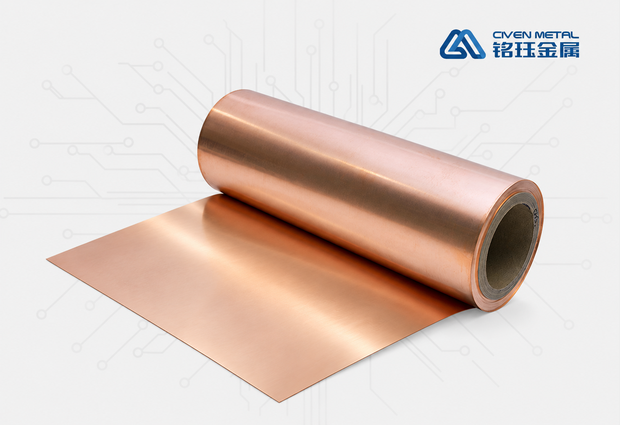
Thickness ranges from 35 to 90 microns, with widths from 4 mm to 250 mm. The specification range is slightly narrower than pure copper foil, which reflects how phosphor bronze foil is used: it is mainly used in spring components that need a certain thickness for mechanical strength, rather than in ultra-thin conductive films. Every micron of thickness serves a structural purpose.