

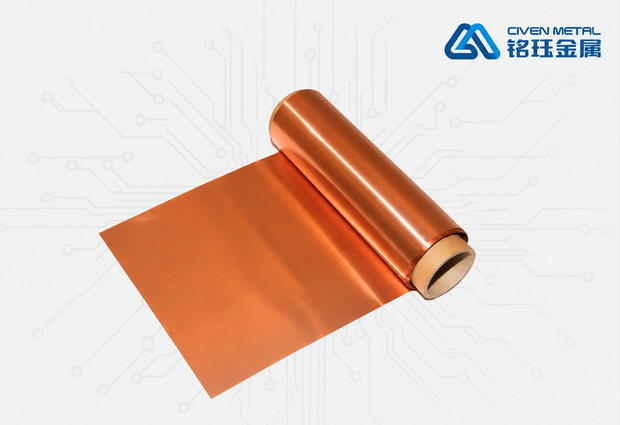
Battery Copper Foil · Current Collector Copper Foil for Lithium Batteries
BCF Lithium Battery Electrodeposited Copper Foil
Double-shiny copper foil designed for lithium-ion battery anode current collectors. Soft enough for winding processes, with thickness steadily moving from 12 μm toward 4 μm, it is a core base material for EV power batteries.
· Product Features
- 4/6/8/10 μm mainstream thicknesses
- Double-shiny surface
- ≥ 30 kg/mm² tensile strength
- ≥ 5% elongation
Roughness Evolution Roadmap
Surface Roughness Evolution
Product Introduction
Product Introduction
BCF (Battery Copper Foil) refers to electrodeposited copper foil used as the anode current collector in lithium-ion batteries. It is a completely different product category from PCB copper foil: PCB foil is engineered for surface roughness (for bonding strength and signal transmission), whereas BCF is engineered for surface smoothness, softness and mechanical strength, because its job is to carry the active material coating inside the battery and provide a path for current collection.
BCF features a double-shiny (double-bright) surface finish: both sides are smooth and mirror-like, with no roughening treatment. This surface serves three key purposes: ① it provides maximum surface area for uniform coating of anode slurry (graphite / silicon-carbon composite + binder); ② it ensures strong adhesion between the coating and the foil, preventing delamination during charge-discharge cycles; ③ it reduces interfacial contact resistance, improving rate capability and cycle life.
Thinner gauges are the single most important technical trend in BCF. Every 1 μm reduction in foil thickness raises battery energy density by roughly 0.5–1% (lower weight + higher share of active material). The industry has moved from an early 12 μm mainstream to today's 8 μm / 6 μm mainstream, and 4.5 μm and even 4 μm grades are being qualified at leading battery makers. Thinner foil means a higher technical bar: tensile strength, elongation and areal weight uniformity must be precisely balanced.
Key Process Characteristics
- Surface finish: Double-shiny on both sides, no roughened side, mirror-smooth
- Mainstream thicknesses: Four mainstream grades: 4 μm / 6 μm / 8 μm / 10 μm
- Tensile strength: ≥ 30 kg/mm² (6 μm and above)
- Elongation: ≥ 3–5% (depending on thickness; thinner foil requires higher values)
- Purity: ≥ 99.7% (electronic grade); low impurities ensure electrochemical stability
- Texture: Soft and easy to wind, suitable for high-speed winding and coating
BCF Double-Shiny Structure & Function
Specifications
Available Specifications & Parameters
All four mainstream thickness grades available, plus custom development services.
Supply Format
- Rolls: width up to 1300 mm (fits wide-format coaters)
- Slitting width customizable to match customer coater width
- Optional packaging with release film
Quality Certifications
- ISO 9001 quality management system certification
- Approved supplier audits by leading battery makers (CATL, BYD, LGES, etc.)
- Compliant with GB/T 24588-2023 national standard for electrodeposited copper foil for lithium batteries
Applications
End-Use Applications
Serving every key sector of electronics manufacturing.
EV Power Batteries
BEV / PHEV power batteries, with 8 μm / 6 μm as the mainstream
Energy Storage Systems (ESS)
Grid-scale storage, residential storage, telecom base station backup power
Consumer Lithium Batteries
Smartphones, laptops, TWS earbuds, smart wearables
Electric Two- and Three-Wheelers
Shared e-bikes, electric motorcycles, low-speed EVs
Power Tools & Garden Equipment
Battery packs for cordless drills, lawn mowers and cleaning equipment
Drones & Low-Altitude Economy
eVTOL aircraft batteries, industrial drone power batteries
Core Advantages
Core Product Advantages
Building differentiated competitiveness.
Thinner Foil, Higher Energy Density
Going from 10 μm to 6 μm can raise cell energy density by about 5–8%
Double-Shiny Surface for Maximum Adhesion
Mirror-smooth surfaces ensure uniform anode slurry coating and high bond strength
Soft Enough for High-Speed Winding
Optimized flexibility matched to 80–120 m/min high-speed winding and coating
High Purity for Long Cycle Life
≥ 99.7% electronic-grade purity, impurities controlled at ppm level to suppress side reactions
Wide-Format Supply
Widths up to 1300 mm fit next-generation wide coating lines and reduce slitting loss
Full Thickness Range
All four mainstream grades (4/6/8/10 μm), a one-stop solution from consumer electronics to EVs
Get BCF Copper Foil Samples & Technical Data
Our technical team can recommend the optimal thickness grade and matching substrate for your specific application.