

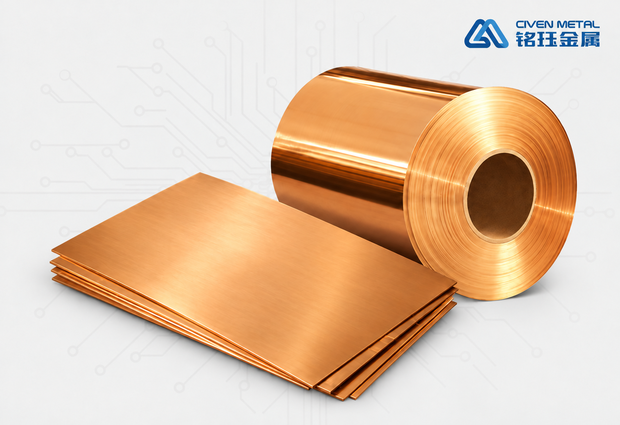
Tin Bronze · Phosphor Bronze
Bronze Strip · Bronze Sheet
Tin-phosphor bronze (Cu-Sn-P) products covering mainstream grades such as QSn8-0.3 and QSn6.5-0.1. Known for high elasticity, excellent wear resistance, fatigue resistance and non-sparking properties, it is the material of choice for high-end electronic connectors, springs, bearings and precision mechanical parts. Custom thicknesses, widths and tolerance grades available.
· Product Features
- 112–124 elastic modulus (GPa)
- ≥250 MPa fatigue strength
- 0.1–3.0 mm thickness range
- 600 mm max width
Key Parameters
Bronze Grades
Tin-phosphor bronze alloys to Chinese national (GB) and major international standards, meeting high elasticity, wear resistance and fatigue resistance requirements.
Available Specifications & Parameters
Full supply range for bronze strip and sheet, with non-standard customization available.
| Product form | Thickness range | Width range | Length (sheet) | Notes |
|---|---|---|---|---|
| Bronze strip | 0.1 – 3.0 mm | 20 – 600 mm | Supplied in coils | Slitting available |
| Bronze sheet | ≥0.5 – 3.0 mm | 20 – 600 mm | ≤ 6000 mm | Sheet thickness 0.5 mm minimum |
Temper
- Soft (M/O) — Annealed, high ductility, suitable for forming
- Half hard (Y2/H) — Balanced strength and elasticity
- Hard (Y/EH) — High strength and elasticity, suitable for spring elements
- Extra hard (T/SH) — Super-hard spring grade, outstanding elastic recovery
Quality Assurance
- Each batch comes with a certificate of analysis (COA), including chemical composition report
- Third-party certification (SGS, CTI, etc.) available
- Compliant with GB/T 2059 (strip) and GB/T 2040 (sheet) national standards
- Supply to international standards such as ASTM B103, JIS H3113 and EN 12163
Key Physical Properties
Typical physical and mechanical properties of tin-phosphor bronze (based on QSn6.5-0.1).
| Property | Value | Unit | Notes |
|---|---|---|---|
| Density | 8.76 – 8.83 | g/cm³ | Varies with tin content |
| Electrical conductivity | 10 – 15% IACS | % IACS | Lower than pure copper and brass |
| Thermal conductivity | 50 – 70 | W/(m·K) | Moderate thermal conductivity |
| Melting point | 900 – 1020 | °C | Solid-liquid range |
| Elastic modulus | 112 – 124 | GPa | Higher than brass |
| Tensile strength (M) | ≥300 – 350 | MPa | Soft annealed temper |
| Tensile strength (Y) | 550 – 750 | MPa | Hard cold-worked temper |
| Elongation (M) | ≥35 – 45% | % | Ductility in soft temper |
| Hardness (HV) | 90 – 200 | HV | Varies with temper |
| Fatigue strength | ≥250 – 300 | MPa | 10⁷ cycles |
| Friction coefficient | 0.08 – 0.15 | — | Good self-lubrication |
Main Applications
With outstanding elasticity, wear resistance and fatigue resistance, tin-phosphor bronze is widely used in high-end manufacturing.
Electronic Connectors
Plug and socket contacts, relay contact springs, switch spring contacts, terminal connectors
Precision Bearings
Self-lubricating bearing bushings, bearing shells, sliding bearings, gear liners, guide rail sliders
Musical Instrument Parts
Piano/organ reeds, brass instrument valve springs, percussion striking parts
Precision Machinery
Bellows diaphragms, pressure sensor elastic elements, precision gears, worm gears
Electrical Equipment
Non-sparking tool materials, explosion-proof electrical contacts, circuit breaker spring assemblies, fuse clips
Chemical Equipment
Corrosion-resistant valve seals, chemical pump shaft sleeves, wear parts for seawater environments
Need custom specifications or a volume quote?
We provide complete certificates of analysis (COA), third-party test reports and export packaging.
Small trial batches and long-term supply agreements supported. Our team will provide technical selection advice.